SHOPPING CART
No products in the cart.



Silicone has become a very common material in products for babies and children. It is used for plates, cups, spoons, bibs and teethers, as well as toys and other accessories. It is flexible, does not break when dropped and is generally easy to clean.
But with such a wide range of products available, one question quickly arises: is silicone safe for babies and young children?
Silicone can be a suitable material for children’s products if the finished product is intended for a specific use and meets the safety requirements that apply to that use. For feeding products, it is particularly important that they are intended for food contact and manufactured so that they are safe for this purpose when used correctly.
This is why simply seeing the word “silicone” is not enough when choosing a product. Its intended use, manufacturer information, appropriate documentation and instructions for use are also important.
Silicone is a synthetic material based on silicon, oxygen and other elements. Depending on its composition and manufacturing process, it can have different properties – in children’s products, it is often used in a soft and flexible form.
These properties are particularly practical in everyday life. A plate does not break when dropped, a bib can be rolled up and packed into a bag, a soft spoon is easy for a child to use, and a silicone teether can be held and explored by small hands.
However, there is something else to keep in mind: the word silicone alone does not tell us enough about the quality and safety of the finished product.
When choosing a children’s product, it is therefore not only important to know what material it is made from, but above all what it is intended for and whether it is suitable for that use.
Silicone can be suitable for food contact if the finished product meets the requirements that apply to materials and articles intended to come into contact with food.
In the European Union, the general principle for food-contact materials is that, under normal or foreseeable conditions of use, they must not transfer substances to food in quantities that could endanger human health, cause an unacceptable change in the composition of the food or adversely affect its sensory characteristics.
There is currently no single specific harmonised EU measure regulating all silicone food-contact materials in the same way. This makes it particularly important to check the intended use of the specific product, the manufacturer’s documentation and the instructions for use.
Parents do not need to know regulation numbers. It is much more useful to know what to check when choosing a particular product.
For plates, cups, spoons and other products that come into contact with food, look for a clear indication that the product is intended for this use.
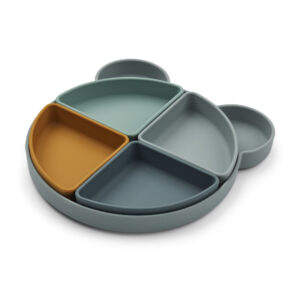
For example, the manufacturer’s documentation for the Liewood Arne silicone divider plate states that it is made from 100% silicone and intended for repeated contact with different types of food. It also specifies conditions of use and testing related to the migration of substances.
Migration of substances is an important part of assessing food-contact materials. It is not only the type of material that is assessed, but also the properties of the finished product under its intended conditions of use.
So rather than simply asking, “Is silicone safe?”, a more useful question is:
“Is this particular silicone product suitable for the way I intend to use it?”
Children’s products often carry claims such as BPA free, “phthalate free” or “PVC free”.
These claims tell us something about the composition of a product, but they do not tell us everything about its overall quality and safety. In addition, certain substances, including BPA, are regulated by European legislation, so a “BPA free” label is not a substitute for the product’s overall compliance with the requirements that apply to it.
When choosing a product for a child, it therefore makes sense to look at the bigger picture.
As children begin to eat more independently, the advantages of a material that is flexible, durable and does not break the first time it falls from the table quickly become apparent.
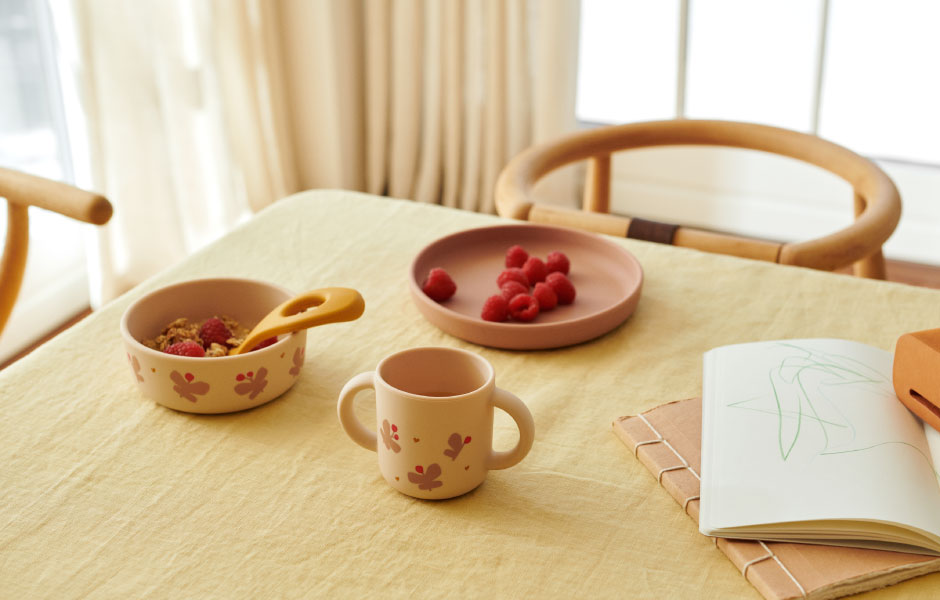
Silicone plates, bowls and feeding sets are therefore particularly practical during the introduction of solid foods and a child’s first attempts at independent eating. On some products, a suction base helps keep the dish more stable on a smooth surface. Softer edges are comfortable to use, and many silicone products can be washed in the dishwasher after a meal.
There is one important rule, however: always check the instructions for the specific product.
Not every silicone product is intended for the same temperatures or the same type of use. Some are suitable for the microwave, while others are not. The same applies to dishwashers, ovens and freezers.
The material may be the same, while the permitted use can differ.
No. The raw materials used, material composition, manufacturing process and properties of the finished product can differ.
For this reason, the safety of a product cannot be reliably assessed simply by its softness, thickness, smell or appearance.
Various home “silicone tests” can be found on social media, where the material is bent, pinched or stretched and its quality supposedly assessed according to a change in colour. Such methods are not a substitute for appropriate product testing and manufacturer documentation.
The safety of a product cannot be determined with a simple home test.
Its intended use, traceability, instructions and the information provided by the manufacturer or responsible economic operator are far more important.
For feeding products, check in particular:
With children’s products, the material alone is not what matters. What matters is the finished product and the use for which it was designed.
Some products include a reference to LFGB. This is the German legal framework covering food, consumer products and animal feed. German BfR recommendations for food-contact materials are also used in relation to silicones.
It is important not to interpret LFGB as a special European “silicone certificate”. It provides information about the requirements or testing referenced by the manufacturer for a particular product.
You may also see the glass-and-fork symbol on food-contact products. It indicates that a material or product is intended to come into contact with food where this intended use is not otherwise obvious.
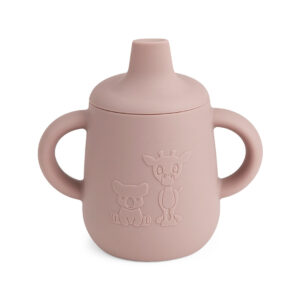
For example, the Nuuroo Aiko silicone cup with straw specifies food-contact silicone (LFGB), while the manufacturer also states compliance with European requirements for food-contact materials and good manufacturing practice. The product is dishwasher safe, and the instructions also recommend inspecting it before each use and replacing it at the first signs of wear.
This type of information is considerably more useful when choosing a product than general marketing terms such as “premium silicone”.
Yes, if the specific product is intended for this purpose and is used within the limits specified by the manufacturer.
Silicone can be a temperature-resistant material, but this does not mean that all children’s silicone products have the same permitted temperatures or methods of use.
Do not assume from the material alone that a product can be used in a microwave, oven or at a particular temperature.
Silicone is generally easy to maintain, but the manufacturer’s instructions should still be followed.
Clean the product thoroughly after use and inspect it regularly, particularly if it comes into contact with food or is placed in the child’s mouth.
If you notice cracks, damage or significant wear, follow the manufacturer’s instructions regarding continued use or replacement. Nuuroo feeding products, for example, state that the product should be inspected before use and replaced at the first signs of wear.
Be careful with sharp objects on silicone plates as well if the manufacturer warns that they may damage the surface.
Different requirements apply to these products than to feeding utensils.
If a silicone product is a toy, it must meet the safety requirements applicable to toys – being made from silicone alone is not enough.
The child’s age, product construction, mechanical properties, potential small parts and intended use are all important.
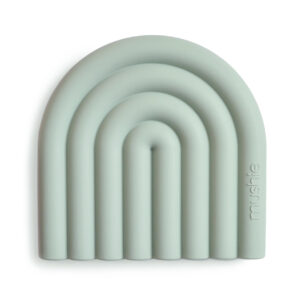
For example, the manufacturer’s declaration of conformity for the Mushie Rainbow silicone teether – Cambridge Blue identifies silicone as the material and states compliance with requirements applicable to toy safety. The product has also been tested according to EN 71-1 for mechanical and physical properties, EN 71-2 for flammability and EN 71-3 for migration of certain elements.
For a teether, therefore, check not only the material but also whether the product is actually intended for teething, what age it is suitable for, how it should be cleaned and what instructions the manufacturer provides for safe use.
It does not make sense to automatically declare one material better simply because of its name.
The safety and usability of a product do not depend solely on whether it is made from silicone or plastic. Its specific composition, manufacturing quality, intended use, applicable requirements and correct use all matter.
Silicone has several very practical properties in children’s products: it is flexible, does not break when dropped and is often easy to clean.
That does not mean every plastic product should automatically be replaced with a silicone one.
A more useful question is:
“Which product is suitable for this purpose and for the way my child will use it?”
Silicone can be a very practical material for everyday life with a baby or young child. For feeding, it allows for flexible and durable products, while teethers and toys can be made in soft shapes that small hands can easily grasp.
But the word “silicone” on the packaging is not enough.
For products that come into contact with food or that a child frequently puts in their mouth, it is worth looking a little further: what the product is intended for, who made it, what information and documentation support it, and how it should be used correctly.
That is also the essence of a considered choice: rather than looking for a material that is declared “the best” in itself, choose a quality product that is suitable for its intended purpose and for the stage in which your child needs it.