SHOPPING CART
No products in the cart.



When choosing a pacifier, we quickly notice that models differ in more than just colour, material and size. One of the most important differences is the shape of the nipple, the part your baby holds in their mouth.
Some pacifiers have a round nipple, while others are flattened or anatomically shaped. Manufacturers highlight different benefits of each shape, so parents often wonder which is best for their child and whether the shape of a pacifier can affect the development of teeth and jaws.
There is no single answer that applies to every baby. It is important to understand the differences between shapes, consider your child’s individual needs and remember that the frequency and duration of pacifier use also influence oral development.
The main difference lies in the shape of the nipple and how it sits inside your baby’s mouth.
A round pacifier has a rounded nipple, often resembling a cherry or a teardrop. It has no designated top or bottom, so it does not need to be positioned in a particular direction.
An anatomical pacifier has a nipple designed to accommodate the space inside a baby’s mouth. It is often flatter on one side and more rounded on the other. With these models, it is important to position the pacifier correctly.
A symmetrical pacifier has a flattened or specially shaped nipple that is identical on the top and bottom. This means your baby can use it in either orientation.
With some pacifiers, including certain FRIGG models, the shape of the shield can help identify the nipple design. This is particularly useful with anatomical pacifiers, as the shield can help you position the pacifier correctly.
Terminology may vary between manufacturers. Some also use the term orthodontic pacifier, but this label alone does not mean that a particular model has been proven to be better for dental development.
Anatomical and orthodontically shaped pacifiers are designed to accommodate the space inside a child’s mouth. However, choosing a particular shape does not mean that potential changes in tooth position or bite development can be completely prevented.
Research suggests that pacifier shape may influence certain changes in the bite, but findings are not consistent enough to identify one shape as the best for every child.
Other factors are also important with prolonged pacifier use, particularly:
It therefore makes sense to consider the shape of the pacifier without overlooking habits associated with its use. If you notice changes in your child’s bite or have concerns about dental development, consult a paediatric dentist.
A round pacifier has a fuller, rounded nipple. Some babies find this shape more comfortable, while others reject it and more readily accept a flattened or anatomically shaped pacifier. This may be related to how the pacifier feels in the mouth, the baby’s sucking pattern and individual preferences.
A pacifier recommended by other parents will not necessarily suit your child. It is also perfectly normal for a baby to accept one shape while repeatedly spitting out another.
Some breastfeeding specialists favour round pacifiers because their shape resembles a nipple during feeding. However, this does not mean that round pacifiers have been proven to improve breastfeeding or that they are the best choice for every baby. If you are experiencing breastfeeding difficulties, seeking individual support is more important than simply changing pacifier shape.
If your child already uses a particular pacifier shape without any problems, there is usually no need to change it simply because of a different appearance or new trends. A change may be worth considering if your child refuses the pacifier, seems uncomfortable with it or a healthcare professional recommends another shape.
When trying a new pacifier, pay attention to whether your child accepts it and whether it sits correctly in their mouth during use. There is no need to force a child to accept a particular shape.
The FRIGG range includes different nipple shapes, making its collections a useful example of how pacifiers can differ in design as well as appearance.
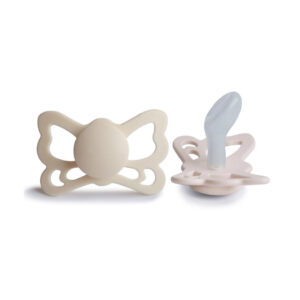
The Butterfly collection features an anatomically shaped silicone nipple. Its upper and lower sides are designed differently, so correct positioning is important during use.
The shape of the shield helps indicate which way the pacifier should face. This is a useful detail, particularly for parents using an anatomical pacifier for the first time.
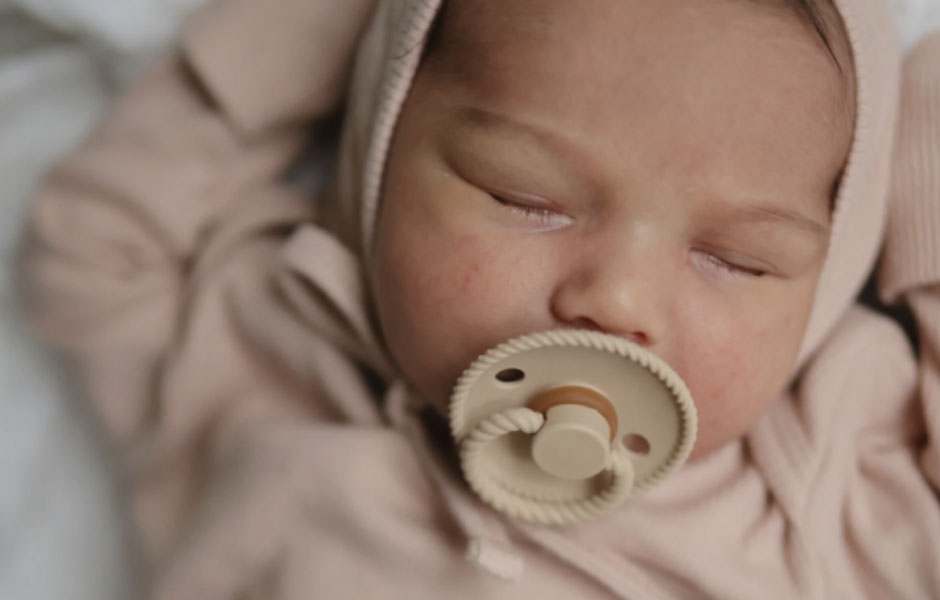
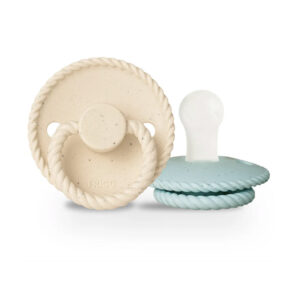
The Rope model is recognisable by the distinctive decorative ring on its shield. The silicone version has a round nipple without a designated top or bottom.
It is an example of a classic rounded shape that some babies find easier to accept.
Mini Mocha combines a round nipple with natural rubber, also known as latex. It therefore differs from silicone versions not only in material but also in flexibility and how it feels during sucking.
When choosing between these models, it is sensible to consider which shape suits your baby first, followed by the material and appropriate size. Colour and appearance can be the final considerations.
Yes. In addition to nipple shape, the material can influence how a pacifier feels inside the mouth.
Silicone pacifiers are generally smooth, flexible and relatively durable. Silicone does not contain natural latex, making it suitable when you want to avoid that material.
Natural rubber or latex pacifiers are also flexible but may feel softer or simply different. Because natural rubber is a natural material, its properties can change over time, making regular checks for wear particularly important.
Differences may also be noticeable in appearance and smell. Silicone is usually transparent and almost odourless, while natural rubber has a characteristic yellowish colour and may have a distinctive smell. However, neither material can be described as universally better for all babies. Some prefer silicone, while others prefer natural rubber.
If your child has a confirmed or suspected latex allergy, avoid products made from natural latex and consult a healthcare professional about suitable alternatives.
Some pacifiers, including FRIGG models, have a valve in the nipple. This allows air to escape from the nipple during sucking, helping its shape respond to pressure inside the baby’s mouth.
Water can also enter the nipple through the valve during cleaning or sterilisation. This does not necessarily mean that the pacifier is damaged. If the manufacturer permits it for the specific model, you can gently squeeze the nipple after cleaning to release the water through the valve. Then allow the pacifier to dry completely.
It is important to follow the manufacturer’s instructions, as recommended cleaning methods vary depending on the material and model.
Nipple shape is only one factor. It is equally important to choose the size recommended by the manufacturer for your child’s age. FRIGG pacifiers, for example, are available in versions for 0–6 months and 6–18 months. However, not all brands use the same age categories.
Before buying, check the recommended age, the size of the shield and nipple, and the instructions for use. If your child is between two size categories, follow the recommendations of the specific manufacturer.
Inspect pacifiers regularly and replace them if you notice signs of wear or damage. Never extend them with strings or straps that are not specifically designed for safe use with a pacifier.
Both matter, but the duration and frequency of pacifier use also play a significant role in its long-term effects on teeth and bite development. For a young baby, a pacifier can be part of soothing and settling to sleep. As the child grows, it makes sense to gradually reduce its use, particularly if they keep it in their mouth for most of the day.
Prolonged and frequent pacifier use is associated with an increased risk of certain bite changes. Therefore, even a pacifier labelled anatomical or orthodontic is not a reason to continue using it indefinitely.
When deciding between an anatomical and a round pacifier, there is no need to search for one universally superior shape. Different babies may accept different nipple shapes more readily, and it is also important that the pacifier is age-appropriate and safe to use.
If your child already accepts a particular pacifier, there is no need to replace it simply because another shape is currently more popular. If they reject it, however, you can try a different design.
Within the FRIGG range, for example, you can choose between the anatomically shaped Butterfly and the round Rope and Mini Mocha models. They also differ in material, so it is worth considering the whole product when comparing them.
The best pacifier is not necessarily the one with the most promising label on its packaging, but one that is safe, suitable for your child’s age and comfortable for them. How often and how long your child uses it remains important too.