SHOPPING CART
No products in the cart.



When you start introducing solid foods, another question quickly follows what to offer your baby: what will they eat and drink from? Bowls, suction plates, spoons, first cutlery, open cups, straw cups and complete feeding sets – there is plenty to choose from. But you do not need everything for those first meals.
To begin with, a plate or bowl, a suitable spoon and a cup are usually enough. More important than the number of pieces is choosing items that suit your child’s current developmental stage and gradually support greater independence.
At first, part of mealtime will still involve help from a parent. But your baby will increasingly want to pick up food independently, reach for the spoon and gradually start holding their cup too.
A basic feeding set can therefore be quite simple:
You can add other items when you realise they would genuinely make everyday meals easier for your child or for you.
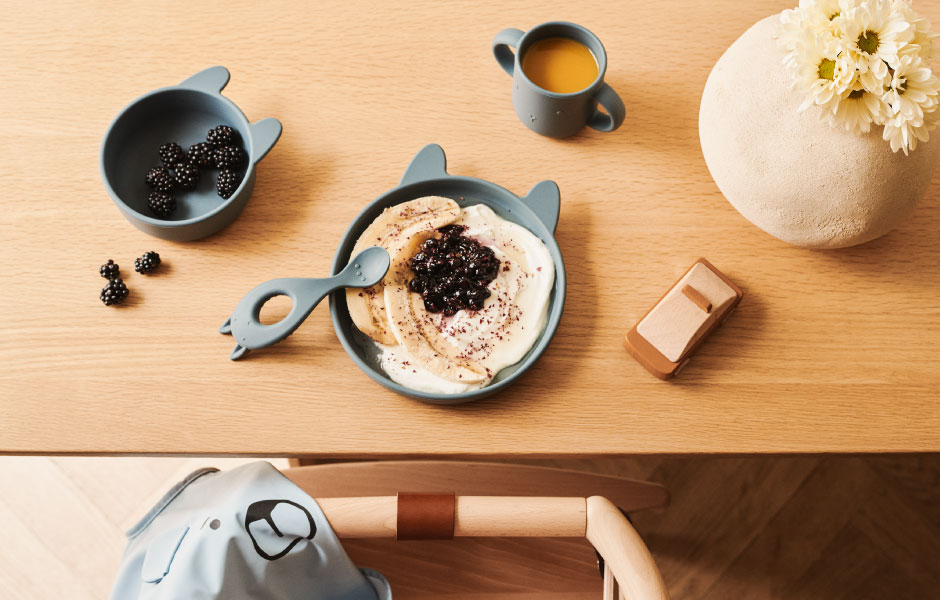
A bowl is often practical for first purées and softer foods, while a plate may become more useful as your child starts eating more independently. A bowl works well for purées, yoghurt and other foods eaten with a spoon. A plate offers more space for different foods and pieces your child can pick up with their hands.
Divided plates can also be practical. They are not essential, but they can make it easier to serve several different foods at once. During the first attempts at independent eating, a slightly raised edge can also be useful, giving your child something to push food against while learning to scoop it up.
With first cutlery, size and shape that are easy for a child to use matter more than appearance. At first, the parent will often hold the spoon, but babies soon start reaching for and holding it themselves. A shorter handle can be easier for small hands to control, while the spoon itself should be appropriately sized for a child’s mouth.
As your child becomes more confident at mealtimes, they can start using a fork alongside their spoon. There is no need to rush – the cutlery should follow the skills your child is currently developing.
You do not necessarily have to choose just one. Some children’s cups and bottles are designed to be used in several different ways. When drinking from an open cup, your child gradually learns how to hold it, tilt it and control the amount of liquid. At first, an adult helps, but over time your child becomes increasingly independent.
A cup or bottle with a straw can be more convenient when you want to reduce spills – for example when travelling, in the pushchair or on a day out.
A practical option is a model where the top with the straw or adapted drinking attachment can be removed, allowing the same product to be used as a regular open cup. You can find this type of design among Liewood and Nuuroo drinking products too.
This means you do not necessarily need a separate cup for every stage. At first, your child can use the adapted top, and later the same product can be used as an open cup – or you can simply change the way it is used depending on the situation.
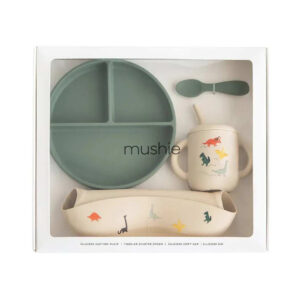
A complete feeding set is most practical when you are actually going to use most of the pieces it contains. If your baby is just starting solid foods and you do not yet have suitable feeding essentials at home, a set can be a simple solution. You get several basic pieces at once that can be used for different meals.
If your child already has a cup that works well or a favourite spoon, it may make more sense to buy only the pieces you are missing.
A set is a good choice when it makes those first meals easier. But it is not automatically a better choice simply because it contains more pieces.
Children’s feeding products are available in different materials, so it does not make sense to choose solely on the basis of whether a product is made from silicone, plastic or something else. What matters more is that the specific product is intended for food contact and suitable for the way you plan to use it. Products used for feeding children must meet the requirements applicable to materials and articles intended to come into contact with food.
When buying a feeding set, it helps to think primarily about how your child will use each item in practice. If they pick up a lot of food with their hands, a good plate may matter more. If they constantly want to hold the spoon themselves, suitable cutlery can make a bigger difference. If you often eat away from home, you may appreciate a cup that is easy to take with you.
And in a few months, your child’s needs may already be different. That is also why there is no single “perfect” first feeding set for every child.
A child’s first plate, cup and cutlery are not simply smaller versions of adult tableware. They can make those first attempts at independent eating easier and allow children to develop new skills gradually. So you do not need a drawer full of children’s tableware from the start. You need a few items that suit the way your child currently eats and drinks.
As they begin scooping up food independently, cutlery becomes more important. When they want to drink on their own, the cup becomes more relevant. And as meals become more varied, the type of plate that works best may change too. A good first feeding set is not the one with the most pieces, but the one that helps your child take the next step towards independent eating at the right time.