SHOPPING CART
No products in the cart.



When temperatures drop, preparing for a walk with your baby changes too. Alongside choosing suitable clothing, we start thinking about how to protect our child from the cold and wind without dressing them in too many thick layers.
A stroller footmuff can be a very practical solution. It provides extra warmth for your child while making everyday preparations for a walk easier for parents. However, not all footmuffs are the same. They differ in size, materials, opening systems and stroller compatibility.
When choosing one, the most important considerations are how and where you will use your stroller, your child’s age and how well the footmuff fits the stroller.
A footmuff helps protect your child’s legs and body from cold air and wind. Its main advantage is that it provides an additional protective layer without having to dress your child in a thick snowsuit for every walk.
This is particularly useful during everyday activities when outdoor walks, short stops and visits to indoor spaces alternate.
With many models, you can open or partially remove the upper section. This makes it easier to uncover your child when the weather gets warmer or when you enter a heated building.
Both have their advantages, but they are not intended for exactly the same use.
A blanket is convenient when you need a lightweight additional layer that can be quickly added or removed. However, with an older child in the stroller seat, it may slip or become uncovered as the child moves.
A footmuff usually wraps around the child’s body more securely and stays in place when correctly fitted. Models designed for stroller seats have openings for the safety harness, allowing your child to be properly secured.
For regular walks in cold weather, a footmuff is therefore often more practical, while a blanket can be a useful addition during transitional seasons.
Whatever you choose, your child’s airways must remain clear. Never place a footmuff or blanket over their face.
No. Although some footmuffs are described as universal, this does not mean they will fit every stroller equally well.
Before buying, pay particular attention to:
If you have a Joolz stroller, it makes sense to consider footmuffs from the same brand, as they are designed for use with certain models in the Joolz range. Nevertheless, compatibility should always be checked for the specific combination of stroller and footmuff.
A footmuff should provide enough room for your child’s legs and allow them to sit comfortably. At the same time, it should not be so large that it bunches up incorrectly inside the stroller or interferes with the harness.
For a younger baby, it is important to choose an option explicitly approved for their age and the way the stroller is being used. A footmuff designed for a stroller seat is not automatically suitable for a newborn carrycot.
For an older child, check the length of the footmuff and the available legroom. Children grow quickly, so it is worth considering whether the chosen model will still be suitable next season.
A footmuff combines an outer fabric, an inner lining and insulation. Each component serves a different purpose.
The outer material helps protect against wind and moisture. The inner lining should feel comfortable against the skin, while the filling provides additional thermal insulation. When comparing products, check whether the manufacturer specifies water repellency, wind resistance and care instructions. The term water-repellent does not necessarily mean that a product is completely waterproof.
It is also important that the footmuff allows you to adapt to different temperatures. A thicker footmuff is not always the better choice, as a child can become overheated when clothing and the footmuff provide too much warmth together.
One of the most common questions is how much clothing a child needs when they are already sitting inside a warm footmuff. The answer depends on the outdoor temperature, wind, your child’s age and how warm the footmuff itself is. When choosing clothing, remember that the footmuff already provides an additional insulating layer.
Children are generally dressed in suitable layers that can be adjusted as needed. During a walk, check how your child feels and whether their chest or the back of their neck feels comfortably warm. Cold hands alone are not a reliable indication that your child is cold.
If your child feels hot, is sweating or has a noticeably warm torso, remove a layer of clothing or open the footmuff.
For a newborn, it is important to distinguish between using a footmuff in a stroller seat and using one in a carrycot.
Many footmuffs are primarily designed for stroller seats, where they are fitted together with the safety harness. This does not mean they are also suitable for a carrycot.
Only use accessories in a carrycot that the manufacturer explicitly approves for that purpose. Do not add extra mattresses, thick liners or other soft items that could affect your child’s safety. With a newborn, it is particularly important to keep their airways clear and avoid overheating.
With everyday use, you quickly discover that warmth, materials and appearance are not the only things that matter.
The following features can be particularly practical:
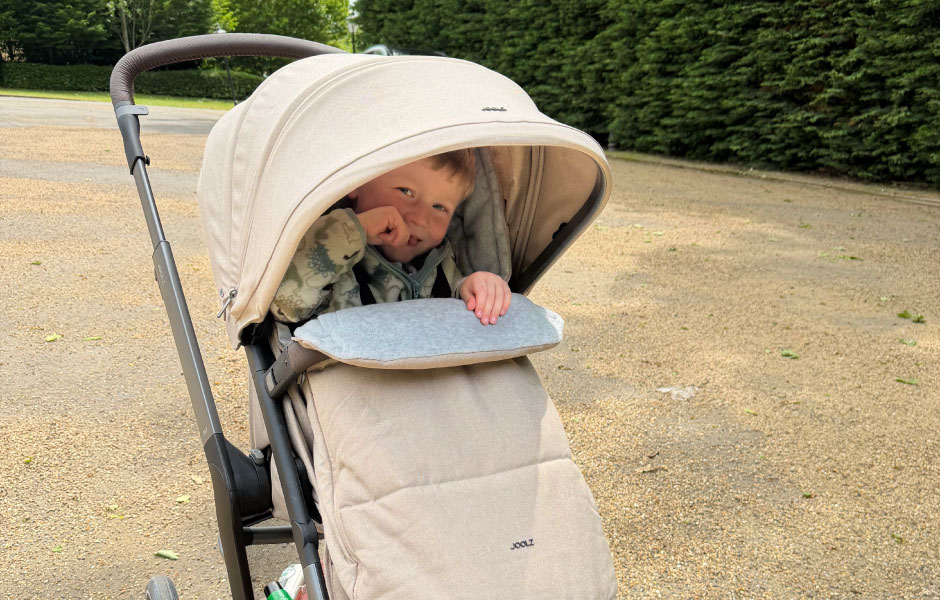
A good example of thoughtful details is a Joolz footmuff, for which the manufacturer highlights a fleece lining, water-repellent outer material, protection against dirty shoes and the option to use it as a seat liner. These features may not be immediately obvious from the first product photograph, but they can make everyday walks considerably easier.
Throughout the season, a footmuff is exposed to moisture, dirt and frequent use, so it is worth checking the cleaning instructions before buying.
Some models can be machine-washed, while others require different cleaning methods. Always follow the care label, particularly regarding washing temperature, drying and the use of fabric softener. If the footmuff becomes wet during a walk, open it afterwards and allow it to dry completely. Before storing it at the end of the season, make sure it is clean and dry.
When choosing a footmuff, do not focus only on its appearance or thickness. Above all, it should be suitable for your stroller, your child’s age and the way you intend to use it.
If you go for lots of walks, you will probably appreciate good wind protection, easy opening and simple maintenance. If you frequently move between outdoor and indoor spaces, a footmuff that can be quickly opened and adjusted will be particularly useful.
Dedicated footmuffs are also available for Joolz strollers, and it is worth checking compatibility with your specific model. Joolz states that its classic footmuff can be used with the stroller seats of several models, including the Day5. However, for the Geo5 and other versions, you should check the exact accessory you intend to use.
A good footmuff is not necessarily the thickest one or the one with the most features. The best choice is one that provides suitable warmth for your child while allowing parents to adapt easily to everyday conditions.