SHOPPING CART
No products in the cart.



A night light is one of those accessories you may not consider essential before your baby is born, but later quickly realise how practical it can be. First during nighttime feeds and nappy changes, and later as part of the bedtime routine, during night waking or on those first independent trips to the bathroom.
When choosing one, a cute design is not the only thing that matters. For nighttime use, the key considerations are the type of light it gives off, how bright it is, how easy it is to operate and whether it can be moved when needed.
A night light is not something every child needs, but it can be a very practical part of an evening and nighttime routine. During the first few months, it is often particularly useful for parents. For nighttime breastfeeding, feeding or nappy changes, you usually do not need a bright ceiling light. A small, gentle light allows you to see enough without brightly illuminating the entire room in the middle of the night.
As your child gets older, the role of the night light changes. Some children do not like complete darkness, while others wake during the night and need a little light to find their way around the room. A night light can also be useful as part of the bedtime routine or later, when your child gets out of bed and goes to the bathroom independently at night.
It is important, however, that a night light does not turn the child’s room into a brightly lit space. The aim is exactly the opposite: to provide as much light as you need and no more.
For evening and nighttime use, soft, dimmed and warmer light is more suitable than very bright, cool or bluish light.
Bright light just before bedtime is not necessary. If your child only needs a light to feel more comfortable in the room, there should be just enough light to softly illuminate the surroundings. The same applies during nighttime feeding or nappy changes. The light should allow you to see your baby and the things you need without having to switch on the room’s main light.
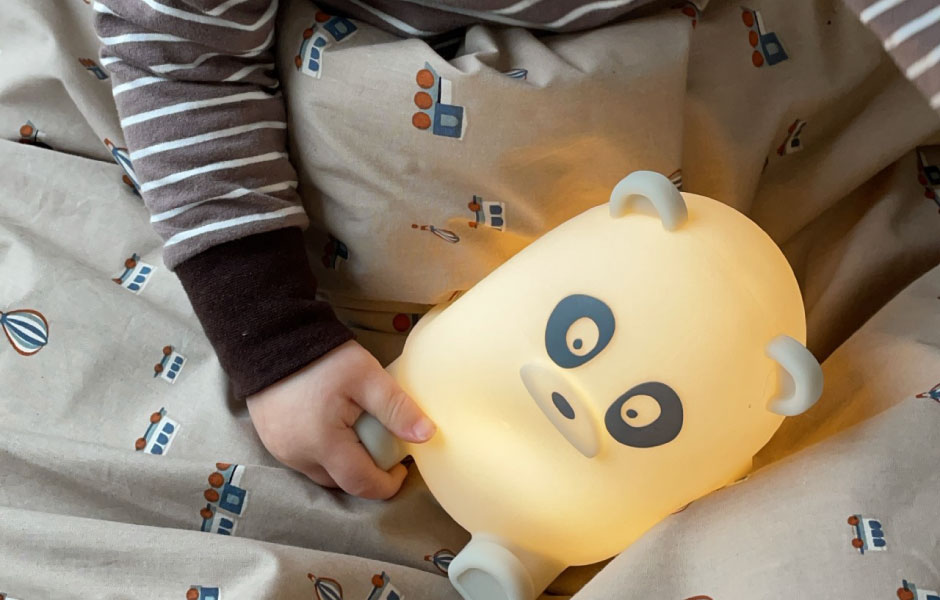
With a child’s night light, the light itself is not the only thing that matters. How your child uses it matters too. Soft silicone lights feel pleasant to the touch and are easy for a child to pick up. Because they are not traditional hard table lamps, they are particularly convenient when you want a light that can easily be moved around the room.
Some models are very simple to operate – by touching or pressing the light, or by using a simple button. This is a small detail that becomes quite important once your child starts using the light independently.
When choosing, therefore, check not only the material but also how the light is switched on and off. Complicated controls or several buttons that are difficult for a child to find in the dark are not necessarily an advantage in everyday use.
Once your child is old enough, simple independent operation is one of the more useful features of a night light. If they can switch it on and off themselves, they do not need to call a parent every time. This is particularly practical for children who wake during the night or already get out of bed independently.
Portability is one of those features that may not seem particularly important at first, but can make a big difference in everyday life. A rechargeable light is not tied to one socket or one place in the room. In the evening, you can use it next to the bed, and at night your child can take it with them when needed.
This becomes especially practical when your child starts going to the bathroom independently at night. Instead of switching on bright lights in the hallway, they can simply pick up their night light, take it with them and then return it to the bedside.
A portable light is also useful on holiday, at the grandparents’ house or anywhere else your child sleeps in an unfamiliar room. This is a good example of why the number of different functions a product offers is not always the most important consideration. Sometimes the most useful feature is a very simple one: being able to take the light with you.
If you are choosing a portable night light, also check how it is powered. Rechargeable models are practical because they do not necessarily need to be connected to the mains while in use. However, it is important to know how the light is charged and approximately how long you can use it between charges.
Before buying, it therefore makes sense to check:
For a child, the best solution is often the one that makes everyday use as simple as possible.
A night light does not need to be placed right next to your child’s head or positioned so that it shines directly towards their face. If your child mainly needs it so the room is not completely dark, you can place it a little further away from the bed. The light should be gentle enough to illuminate the room rather than your child’s face.
If you mainly use it for nighttime feeding or nappy changes with a baby, place it so that it illuminates the area where you need it. This means you will not have to switch on the main light in the middle of the night. With portable lights, another advantage is that their position does not have to be permanent – in the evening it can be next to the bed, during feeding it can be beside you, and later your child can take it with them when needed.
Over time, a night light can also become one of the small signals that the day is coming to an end. You turn off the bright lights, switch on a gentle night light, read a story and get ready for sleep. The light itself is less important than repeating a similar sequence every evening, as your child gradually begins to associate these individual steps with winding down and going to sleep. For an older child, switching the light on and off can also become their own part of the bedtime routine. They can switch it on before their bedtime story and turn it off when they are ready to sleep.
When choosing a night light, start by considering when and how you will use it.
For nighttime feeding and nappy changes, the priority is a gentle light that does not illuminate the entire room. For an older child, simple controls, the ability to switch the light on and off independently and portability become more important.
If your child will use the light independently, a practical choice is a soft, lightweight and easily portable light that they can take with them when needed.
There is no need to look for the model with the most modes, colours or additional features. A good night light is primarily one that provides just enough light and is so simple to use that it becomes an unobtrusive but useful part of the bedtime routine.