SHOPPING CART
No products in the cart.



After bath time, we want to dry our child as quickly as possible and wrap them in something comfortable. For a baby, this is often a hooded towel, while later a bath poncho and bathrobe become useful too. At first glance, they all serve a similar purpose, but in practice there are some important differences.
A hooded towel is usually the most practical option for babies and younger children, a poncho is a great choice for active children and for the beach or pool, while a bathrobe becomes more useful once a child can put it on and wear it independently. Material is therefore not the only thing to consider. It is also worth thinking about your child’s age, how the item will be used and where you will need it most often.
A hooded towel allows you to quickly wrap your baby after a bath while also covering their wet head. This is exactly why it is one of the most practical options during the first months and years.
For a small baby, the most important thing is that the towel is large enough to wrap them comfortably. The hood stays on the head, while the rest of the towel can be wrapped around the body. This is particularly practical during evening bath time, when you move your baby from the bath to the changing mat and want to dry and dress them as quickly as possible. It is therefore a good idea to have the towel within reach before bath time so you can lift your baby directly from the bath into it.
When choosing a towel, pay attention to its size too. A very small towel may be sufficient for a newborn, but your baby can quickly outgrow it. A slightly larger hooded towel can be used for longer and provides enough fabric to wrap your child comfortably.
A bath poncho becomes particularly practical once a child no longer wants to sit still wrapped in a towel after bath time. It is simply pulled over the head, so it stays in place even while the child walks and plays. This is its biggest advantage over a traditional towel.
As toddlers become more active, an ordinary towel quickly ends up on the floor. A poncho covers the body while leaving the child’s arms free, allowing them to move around while they continue to dry.
It is therefore very useful:
The hood also helps dry wet hair and covers the head when the child gets out of the water. A poncho can be especially practical in summer. After swimming in the sea or pool, the child can stay in it for a while without needing to be changed immediately.
A bathrobe makes the most sense for slightly older children who can already wear it comfortably and put it on themselves. Compared with a poncho, it is more like a regular item of clothing. It is suitable for morning and evening routines, after a bath or shower, as well as at the pool and on holiday.
For a younger child, a poncho is often simpler because it can just be pulled over the head. For an older child, a bathrobe can provide a little more independence – they can put it on, fasten or tie it, and take it off themselves.
When choosing one, check how the bathrobe is designed. The length, sleeves and fastening or tie are important, as the child should be able to walk and move around normally while wearing it.
The main difference is how they are used: we wrap a child in a towel, while a child wears a poncho. For a baby, wrapping is usually more practical because after bath time we are already holding, drying and dressing them. Once a child starts walking independently and wants to run off immediately after getting out of the bath, the advantage of a poncho becomes quite clear.
This means one item does not necessarily have to completely replace the other. A hooded towel can stay at home for evening baths, while a poncho can be used at the pool, by the sea or during water play.
For towels, ponchos and bathrobes, the most important thing is that the material absorbs moisture well, feels pleasant against the skin and is suitable for frequent washing. Cotton is a common choice, but even among cotton products there are differences in texture, thickness and how the fabric feels against the skin.
For cotton towels, terry cloth is a common choice. Its characteristic loops absorb moisture well and give the fabric a soft, comfortable feel. Terry cloth is therefore a practical option for everyday use after bathing, as well as for ponchos and bathrobes.
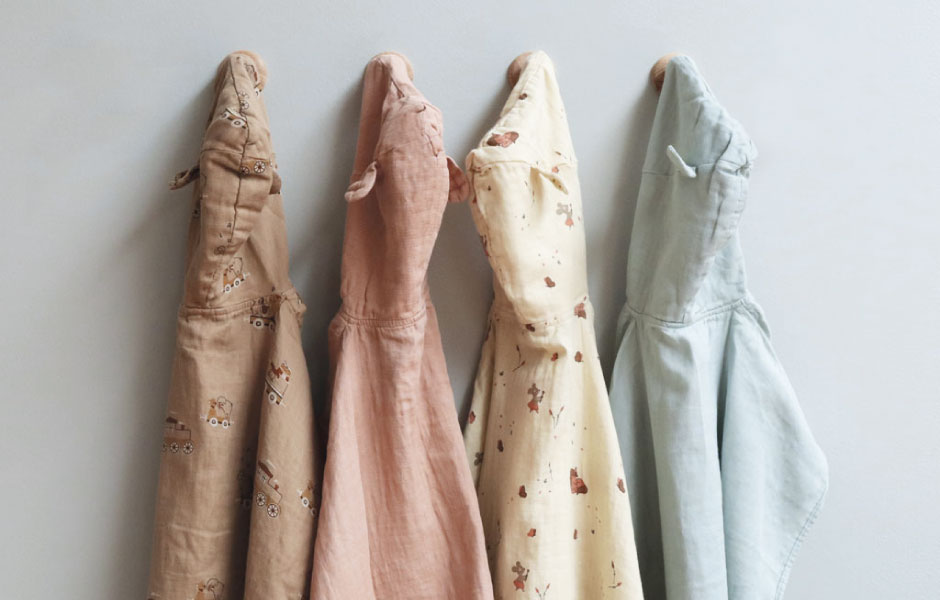
Another option is cotton muslin, which is lighter, breathable and softer to the touch. Thanks to its lightweight feel, it can be an especially comfortable choice for newborns and babies who we want to gently dry and wrap after bath time. Muslin towels also take up less space, making them practical for a changing bag, travel or summer days.
When choosing, don’t look only at the composition on the label. It is also important to consider how the fabric is made and what you will use the product for. For use at home, you may appreciate thicker, highly absorbent terry cloth, while a lightweight muslin towel may suit you better for a newborn or when travelling.
The right size is one that covers the child sufficiently without restricting their movement. A towel needs enough surface area for wrapping, while with a poncho or bathrobe it is also important to consider how the item actually fits the child.
For a hooded towel, check the overall dimensions of the towel first. An age recommendation can be a useful guide, but the child’s actual size is often more helpful.
A poncho should provide enough room for comfortable arm movement, while the lower part should not be so long that it gets in the way when the child walks.
The same applies to a bathrobe: a little extra room is useful, but an oversized robe with long sleeves and a hem close to the floor is not necessarily practical.
For the pool and beach, a poncho is often the most practical choice because a child can keep wearing it after getting out of the water. For a younger baby, however, a large hooded towel may still be more convenient.
At the pool, it is useful to be able to quickly dry the child and put something on them before heading to the changing room. Here, a poncho works almost like a combination of a towel and a lightweight item of clothing. The same applies at the beach. When the child comes out of the water, simply pull on the poncho and they can continue playing.
For a baby who is usually picked up or placed on a changing mat after bathing, a traditional hooded towel is often still the most practical choice.
There is no universal rule. It is more useful to think about where you use them and how often you wash them.
If you always keep one towel at home but regularly need another for the pool, holidays or visits to grandparents, having several can be very practical. The same applies if your child bathes every day and you always want to have a clean one ready. A combination of different products can also make more sense than several identical ones – for example, a hooded towel for bath time at home and a poncho for the pool or summer.
Because they are often wet and washed regularly, it is important to follow the manufacturer’s washing and drying instructions. After use, the item should be allowed to dry completely as soon as possible. A wet poncho or towel should therefore not be left rolled up in a pool or beach bag for long periods.
Before first use, it is a good idea to wash the item according to the manufacturer’s instructions and then adapt the washing method to the material. For products made from absorbent fabrics, also check the recommendations regarding fabric softener, as instructions can differ between products.
The decision becomes quite simple when you start with how the child will actually use the item. For a baby who is wrapped and dried after bath time, a hooded towel is very practical. For a toddler who would rather immediately continue playing after getting out of the water, a poncho may be the better choice. A bathrobe becomes more useful for an older child who can wear it like a proper item of clothing after bathing.
There is therefore no single product that is best for every age and every situation. The right choice is the one that suits your child’s age, how it will be used and your everyday routine – at home, at the pool or by the sea.