SHOPPING CART
No products in the cart.


During the first months, the way a baby explores the world changes rapidly. At first, faces, sounds and strong visual contrasts capture their attention. Soon they begin to follow objects, reach for them, grasp them and eventually explore them with their mouth. A toy that fascinates a newborn may therefore offer a very different experience just a few months later.
When choosing first toys, the most important question is not how many functions they have. It is more useful to consider what your baby can actually do with the toy at their current stage: look at it, listen to it, grasp it, squeeze it, turn it, transfer it from one hand to the other or move towards it.
Age recommendations are useful guidelines, but babies do not all develop at exactly the same pace. Alongside the age printed on the packaging, consider what your baby can currently do and what captures their interest.
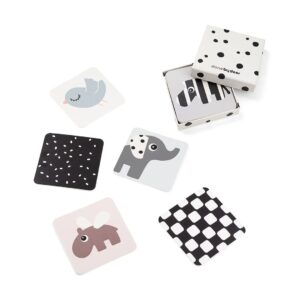
For newborns, simple toys and objects they can look at or listen to are particularly suitable – such as high-contrast cards, gentle sounds and lightweight hanging toys. At this stage, play does not yet mean actively grasping and moving objects.
Newborns are also strongly attracted to something that cannot be found in a shop: their parents’ face, voice and touch. A toy is therefore primarily another way to offer them something interesting to observe.
High-contrast cards can, for example, be placed near the changing area or used during short periods of awake time. Your baby does not need to look at them for long. A few moments of interest are quite enough at this age.
For hanging toys, choose designs that are not visually overwhelming and can be positioned at a safe distance. Once your baby becomes more active and starts reaching for objects, the way the toy is used should be adapted to their new developmental stage.
Over the following months, babies increasingly track objects with their eyes, become interested in sounds and gradually start reaching towards things that catch their attention. At around four months, many babies begin trying to grasp nearby toys and may also shake them.
At this stage, interesting options include:
The size and weight of the toy are particularly important. If your baby is only beginning to grasp objects, a very heavy or awkwardly shaped toy offers little opportunity for independent exploration.
A well-chosen toy allows your baby gradually to reach it, touch it and eventually grasp it. Through these small repetitions – looking, reaching, touching and grasping – play becomes increasingly active.
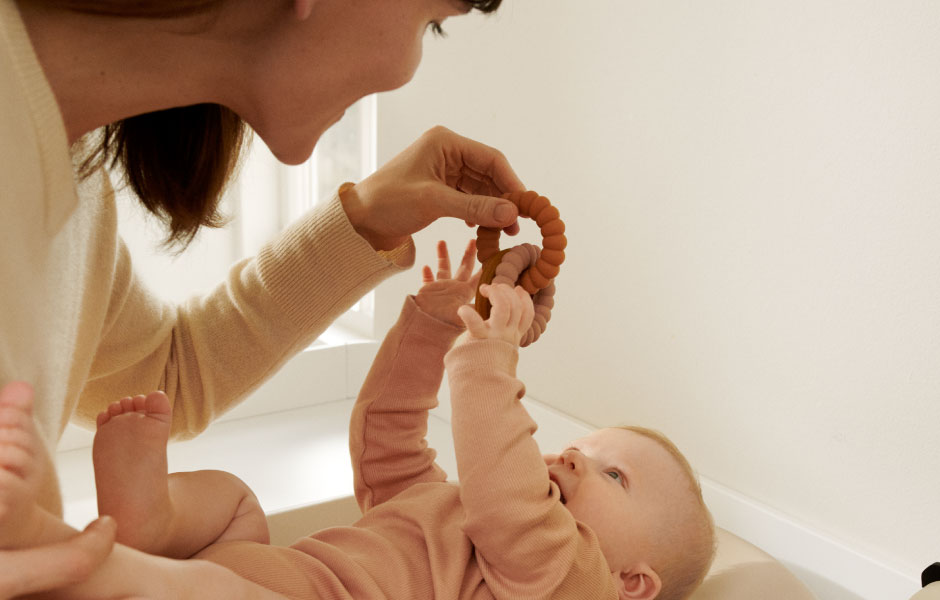
Once your baby begins grasping objects independently, lightweight toys that can be safely held, turned and explored with the hands and mouth are suitable. At this stage, a toy is no longer simply something to look at. Your baby grasps it, drops it, finds it again, brings it closer to their face and often puts it straight into their mouth. Exploring objects with the mouth is a normal part of discovering the world during the first year.
When choosing a toy, make sure that:
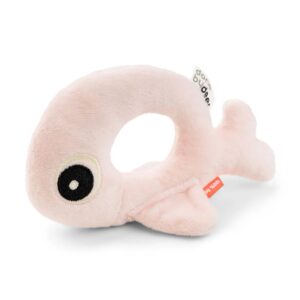
Simple rattles, rings, soft sensory toys and teethers with several easy-to-grasp areas are good examples.
As babies begin bringing more objects to their mouth, teethers can also become useful. Their main advantage is that they are specifically designed to be held and explored with the mouth.
Four things are particularly important when choosing a teether: material, size, shape and ease of cleaning.
A teether should be large enough to use safely while still being shaped so that small hands can grasp it. Some models also feature different surfaces and textures that offer another way to explore. However, not everything a baby puts in their mouth should automatically be interpreted as a sign of teething. At this stage, the mouth is also an important way of exploring objects.
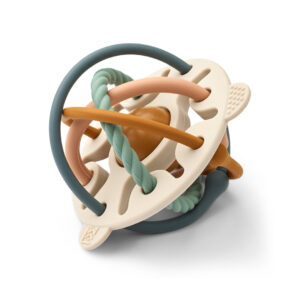
Between approximately four and six months, toys that babies can actively grasp, shake, turn and explore with several senses become particularly interesting. The possibilities now become much broader. Alongside rattles and teethers, suitable choices may include soft balls, sensory toys, different rings and toys that produce a simple result when the baby acts on them – such as a sound or movement.
These toys do not “guarantee development”. They do, however, offer opportunities to repeat movements and explore the connection between an action and what happens to the toy. When a baby shakes a rattle and hears a sound, drops it and watches where it falls, or tries to reach an object during tummy time, even one simple toy can offer several different ways to play.
At around six months, many babies can grasp objects more reliably, transfer them between their hands and try to reach things that interest them. Over the following months, sitting, moving around and increasingly intentional exploration of objects become part of their play.
You can now offer:
Your baby may use a toy completely differently from the way the manufacturer imagined. They may not yet stack rings “correctly” – instead, they might grasp them, bang them together, throw them on the floor or transfer them between their hands.
And that is perfectly meaningful play.
There is no need to wait until a baby knows how to use a toy in the “correct” way. What matters is that the toy is appropriate for their age and offers opportunities for exploration that match what they can currently do.
Toys that encourage reaching, grasping, turning, transferring objects between the hands and later moving towards an object can support opportunities for motor practice. For a younger baby, this might simply be a lightweight rattle placed within reach. Later, an interesting toy can be placed slightly further away during tummy time, giving the baby a reason to turn or reach towards it.
There is an important distinction, however: a toy does not develop a child by itself. Development is supported by the baby’s own activity – trying to reach an object, grasping it, dropping it, picking it up again and exploring it. The toy is a tool that can provide an interesting reason to move and repeat an action.
The most complicated toy is therefore not necessarily the most useful one.
No. A baby does not need a large number of different toys for meaningful play. Much early learning happens through interaction with adults and simple play. That does not mean toys are unimportant or not worth buying. What matters more is variety in the ways they can be used.
One toy might offer sound, another an interesting texture, a third an easy shape to grasp, while another encourages movement. When a particular toy becomes interesting at a certain developmental stage, it can be introduced into play; once the baby outgrows it, something different can take its place.
That is a more useful way of thinking than focusing on how many toys a baby should have.
Safety is particularly important for babies because they frequently explore toys with their mouths. Before buying, check the age recommendation, manufacturer’s warnings, quality of construction and any small parts. After purchase, inspect the toy from time to time. A split seam, damaged component or part that has become loose with use means the toy should no longer be used until it is safe again.
Take particular care with products containing small parts and batteries. If a toy contains batteries, the battery compartment should be appropriately secured so that the child cannot access them. Small button batteries are particularly dangerous if swallowed.
When buying toys on the European market, also check the required markings and manufacturer information. Markings alone do not replace correct use: always follow the stated age recommendations, warnings and instructions for the specific toy.
Age is best understood as a guideline, as babies do not all develop according to exactly the same timetable.
| Age | What babies often explore | Examples of first toys |
| 0-2 months | faces, visual contrasts, sounds | high-contrast cards, simple hanging toys |
| 2-4 months | tracking, reaching, first grasps | lightweight rattles, soft and hanging toys |
| 4-6 months | grasping, turning, exploring with the mouth | teethers, rings, sensory toys |
| 6 months+ | transferring, dropping, moving, cause and effect | balls, stacking toys, larger rings, simple interactive toys |
If your baby is not yet doing everything listed for a particular age, that alone does not mean anything is wrong. Developmental milestones are a framework, not a competition.
There is no need to wait for an exact month on the calendar. The best sign is a change in the way your baby plays. If they previously only looked at an object but now reach towards it, you can offer something they can grasp. When they begin turning objects and bringing them to their mouth, textures and teethers become more interesting. Once they sit, drop objects and look for them, you can introduce toys that allow them to explore stacking, movement and simple connections between an action and its result.
This way, toys follow the baby – rather than the baby having to follow the toys.
When choosing first toys, there is no need to look for the product that promises the most. It makes more sense to consider what your baby can actually do with it at their current developmental stage.
For a newborn, that might mean looking at a high-contrast image. A few months later, grasping a rattle. Then turning a teether, transferring a ball between the hands or trying to reach a toy positioned slightly further away.
That is why a good selection of toys changes as your baby grows. At Mimelo, we look for toys with a clear purpose, quality materials and enough space for children to explore in their own way – at the right time and in a way that suits their developmental stage.