SHOPPING CART
No products in the cart.



A pacifier is one of those small baby essentials that seems fairly simple to choose at first. Then you encounter different sizes, nipple shapes and materials – and the question of which pacifier will actually suit your baby.
There is no universal answer. Some babies accept one shape immediately and firmly reject another, while others do not need a pacifier at all. The most important thing is to choose a pacifier that is appropriate for your baby’s age, manufactured in accordance with relevant safety requirements and shaped in a way that suits your baby. Design and colour can come afterwards.
There are four main things to consider when choosing a pacifier: size, nipple shape, material and shield design. The size should be appropriate for your baby’s age, while the shape and material of the nipple mainly affect how it feels in the mouth. As every baby is different, it is not unusual to try more than one option before finding the one your baby prefers.
There is therefore no need to search for the “perfect” model when buying your first pacifier. It is more important to choose a high-quality, age-appropriate pacifier and then see how your baby responds to it.
Pacifier size should be chosen according to your baby’s age and the individual manufacturer’s recommendations. Sizing labels are not necessarily identical across brands, so it is better to check the recommended age for the specific product rather than relying solely on labels such as “size 1” or “size 2”.
FRIGG pacifiers available at Mimelo, for example, come in two basic sizes:
The difference is not only in the label. The FRIGG size 1 nipple is 27 mm long, while size 2 is 30 mm long.
Nipple shape is probably one of the features where parents quickly discover that babies have preferences of their own. You will most commonly find three basic shapes:
A round pacifier has a rounded, cherry-shaped nipple. Its shape is the same regardless of its position in the mouth and it is one of the classic pacifier designs.
A symmetrical pacifier has a flatter, symmetrical nipple. Because the nipple is symmetrical, it sits correctly regardless of which side is facing upwards.
An anatomical pacifier is designed with a defined top and bottom and is shaped to sit in a particular position in the baby’s mouth.
FRIGG offers all three shapes – round, symmetrical and anatomical. Which one is best? The one your baby accepts comfortably and that is appropriate for their age. If your baby consistently rejects one shape, trying another can make more sense than persisting simply because you originally chose a particular model.
Besides shape, one of the main differences between pacifiers is the nipple material. The most common options are silicone and natural rubber, also known as latex.
Silicone is smooth, has no characteristic smell or taste and retains its shape. These properties make it a very common choice for pacifiers. If you want a material that changes less with use and is easy to care for, silicone is a practical option.
Natural rubber, or latex, is a softer and more flexible material. Because it is a natural material, it can gradually change with use – becoming softer, changing shape or increasing slightly in size.
FRIGG, for example, notes that a natural rubber nipple may expand with use, which makes regularly checking its condition particularly important. Some babies strongly prefer the feel of one material over another. Here too, there is no single option that works for every baby.
It is important to inspect pacifiers regularly and replace them as soon as you notice damage, cracks, changes in the material or other signs of wear. Before use, pay particular attention to the nipple and gently pull it in different directions. If the material is damaged or weakened, stop using the pacifier.
With natural rubber pacifiers, also watch for changes in size, texture or stickiness, as natural rubber changes over time with use. Always follow the specific manufacturer’s instructions regarding product lifespan, cleaning and replacement. A pacifier is one of those products where “it will last a little longer” is not the best approach.
Cleaning methods depend on the material and the manufacturer’s instructions, so always follow the guidance supplied with the specific pacifier. FRIGG recommends placing the pacifier in a bowl, pouring boiling water over it and leaving it to soak for approximately 3–5 minutes.
Most importantly, avoid cleaning methods that the manufacturer does not recommend for the chosen material. With natural rubber in particular, excessive temperatures or prolonged exposure to heat can affect the material.
Allow the pacifier to dry thoroughly after cleaning and inspect it before using it again.
When choosing a pacifier, most attention tends to go to the nipple, but the outer part also has an important safety function. The shield should be large and sturdy enough to prevent the baby from pulling the entire pacifier into their mouth and should include openings that allow airflow.
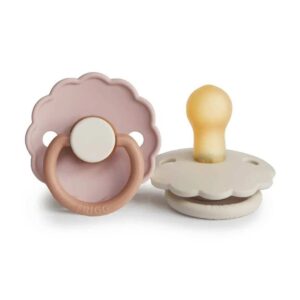
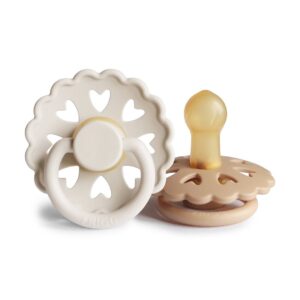
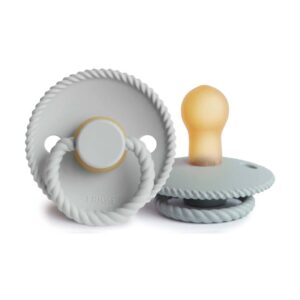
The shape of the shield can also affect how the pacifier sits against the face and how much air circulates around the sensitive skin surrounding the mouth. With FRIGG collections, the shield is also what gives each collection its distinctive appearance – from the characteristic floral openings of Daisy to the rope motif of Rope and the fairytale-inspired details of Fairytale. Design can therefore remain part of the choice without becoming the only criterion.
Many babies use a pacifier mainly to settle before sleep. Sucking can be soothing, and over time a pacifier may become part of the bedtime routine – much like a lullaby, soft lighting or a familiar way of settling down.
If your baby drops the pacifier while sleeping, there is no need to put it back into their mouth every time. Some babies fall asleep with it and then let it fall out naturally, while others use it for longer.
If your baby does not want a pacifier, there is no need to force it. Just as with shape and material, babies differ – for some, a pacifier is very useful for settling, while others barely need one.
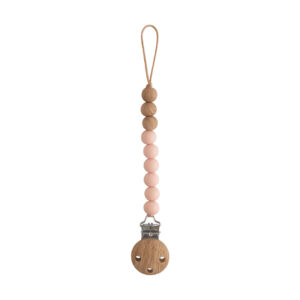
A pacifier clip is primarily a practical accessory when you are out and about with your baby – it helps keep the pacifier from landing on the floor every time it is dropped. Safe use is important, however. Never attach a pacifier around your baby’s neck or extend it with cords, ribbons or other accessories that are not intended for this purpose.
Use only clips designed for pacifiers and attach them to your baby’s clothing according to the manufacturer’s instructions. Check the clip regularly as well and stop using it if it becomes damaged.
You may choose the right size, a high-quality material and a beautiful design – only to discover that your baby has a completely different opinion. This does not necessarily mean there is anything wrong with the pacifier.
You can try a different shape or material, but there is no need to introduce a pacifier at all costs. Some babies use one frequently, others only when falling asleep, while some never accept one. That is why, when buying pacifiers for the first time, trying a few different options can make more sense than immediately buying several of the same shape.
To summarise, check these key points:
When choosing a pacifier, we can check its material, size, safety requirements and quality of construction. But the baby often has the final say. There is therefore no need to search for one shape that is “best” for every baby. It makes more sense to understand the differences and then choose a safe, age-appropriate pacifier that your baby accepts comfortably.
At Mimelo, we have therefore selected FRIGG pacifiers in different sizes and collections, so the choice is not limited to colour or appearance alone. A considered choice begins with what your baby actually needs at a particular stage.