SHOPPING CART
No products in the cart.



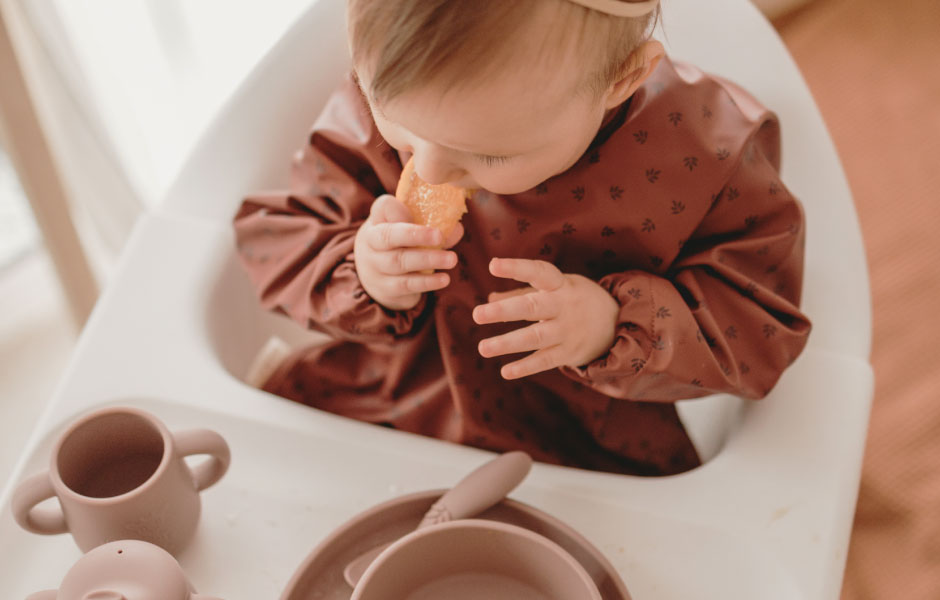
A baby’s first meals are a completely new experience. New flavours, textures and smells – and often considerably more food on the bib, table and floor than in their mouth.
Starting solids also brings a new question for parents: what do we actually need for those first meals?
There is a huge choice of baby plates, bowls, spoons, cups and bibs, but you do not need everything at once. It is far more important to choose a few items that are appropriate for your baby’s age, suitable for food contact and practical enough for everyday use.
At Mimelo, we look at feeding essentials primarily through the lens of everyday life: how easy they are to use, how simple they are to clean and whether they can support your baby as they gradually learn to feed themselves.
Solid foods are generally introduced at around six months of age, when your baby is developmentally ready for their first meals. The process is gradual – from those first tastes and suitable textures to an increasingly varied diet.
First meals are not only about discovering new flavours. Your baby is also gradually learning to sit during meals, grasp food and cutlery, drink from a cup and become increasingly involved in feeding.
The right equipment can therefore make those first meals considerably easier – for both baby and parents.
To begin with, a spoon, a small bowl or plate, a cup and a practical bib are usually enough. As your baby starts picking up more food independently and becomes more confident at mealtimes, you can gradually add other items.
Rather than buying a large set straight away, think first about what you will actually use at every meal.
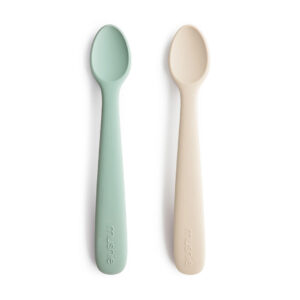
A spoon is usually one of the first pieces of cutlery your baby encounters.
For first meals, a small spoon with a shape and size suited to a baby’s mouth is practical. Once your baby begins to hold it independently, the handle also becomes important – it should be short enough and easy for small hands to grasp.
At first, you will probably do most of the feeding, but your baby may quickly become interested in exploring independently. Having two spoons at the table – one for you and one for your little explorer – can therefore be surprisingly useful.
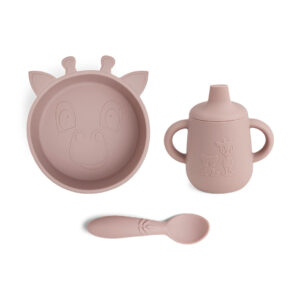
For early purées and softer foods, a small bowl is often particularly practical because it makes scooping food with a spoon easier. As your baby starts eating a wider variety of foods and picking up individual pieces independently, plates become increasingly useful too.
A divided plate can be useful later, when you want to offer different foods separately and allow your baby to explore different flavours and textures. The first plate does not need to be complicated, however. Stability, an appropriate size and easy cleaning matter more.
A suction base can help keep a plate or bowl more stable on a smooth surface during meals. This can be particularly practical once your baby starts reaching for food and exploring everything in front of them.
Of course, suction does not suddenly make mealtimes mess-free. Babies tend to be rather inventive in that department. It can, however, reduce the amount a dish moves around the table and make it easier for your baby to concentrate on picking up food or using a spoon.
First meals also mark the beginning of learning to drink from a cup. There are open cups, cups with handles, spout cups and various transitional designs. The same type will not necessarily suit every baby.
For those first attempts, the most important thing is that the cup is small and light enough for your baby to gradually begin holding it independently.
An open cup allows your baby to learn a different way of drinking, while cups with handles or spouts can be practical at certain stages and especially when you are out and about.
Instead of searching for one “perfect” cup, think about where and how you will use it.
One thing is almost guaranteed with first meals: mess.
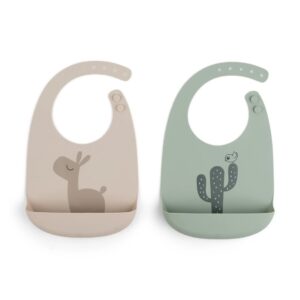
A good bib can therefore quickly become one of your most frequently used feeding essentials. Designs that can be quickly wiped or washed and feature a food-catching pocket are particularly practical. The pocket catches at least some of what would otherwise end up on your baby’s lap or on the floor.
Also consider the fastening and whether the fit around the neck can be adjusted. If you plan to use the same bib for a longer period, being able to adapt it as your baby grows is useful. It is one of those products where practicality tends to become much more important after just a few meals.
Silicone is a popular choice for baby tableware, largely because it is practical. It is soft and lightweight, does not break when dropped, and silicone products are generally easy to clean – something that quickly matters when first meals begin.
Alongside shape and usability, it is worth checking the quality of the material and its suitability for food contact. Products intended for feeding children should be made from materials that are safe for their intended use and comply with applicable European requirements for food-contact materials.
At Mimelo, this means that when selecting feeding products we consider not only their appearance and practicality, but also their materials, intended use and the appropriate documentation provided by manufacturers.
Once first meals become part of everyday life, it is not long before you need to serve one away from home. This is where products you may not even need at home become particularly useful: bottles, food storage containers, insulated food jars and cutlery that can easily travel with you.
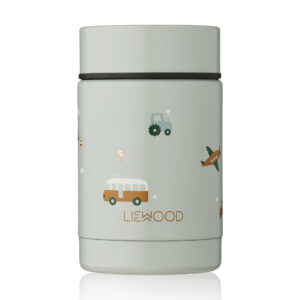
An insulated food jar, for example, is useful when you want prepared food to stay warm or cold for longer. When choosing one, consider its capacity, closure and the manufacturer’s instructions regarding temperature retention and use.
For shorter trips, a small, securely closing food container may be all you need. A useful rule for feeding on the go is simple: choose items you can pack quickly, close securely and clean easily.
With first meals, it does not matter how quickly your baby begins eating independently. Some babies show an early interest in reaching for food and spoons, while others need help with feeding for longer. What matters is giving your baby the opportunity to explore food at their own pace while paying attention to their signs of hunger and fullness.
Appropriately chosen feeding equipment can help. A spoon that is easy for small hands to grasp, a stable bowl and a lightweight cup allow your baby to gradually become more involved in meals and try doing more things independently.
At first, the spoon may spend more time on the floor than in your baby’s mouth. A few weeks later, they may already be using it very differently. Independent eating develops step by step – together with your baby.
Alongside discovering new flavours, first meals should take place in a safe feeding environment. Always adapt the texture, shape and size of food to your baby’s age and developmental abilities, and make sure your baby is seated in an appropriate position and supervised by an adult throughout the meal.
As your baby develops, they can gradually explore different textures and an increasingly varied range of foods. Take particular care with foods and shapes that present a greater choking risk and prepare them in a way that is appropriate for your baby’s developmental stage.
If your baby has specific dietary needs, allergies or feeding difficulties, or if you are unsure how to proceed with introducing particular foods, consult your paediatrician or another appropriately qualified healthcare professional.
To keep things simple, I would start with:
Everything else can be added once you see what mealtimes actually look like for your family.
Starting solids is not simply the point when first foods are added alongside milk. For your baby, it marks the beginning of an entirely new way of exploring the world – through taste, touch, smell and increasing independence.
That is why choosing products for Feeding is not about having everything. It is about selecting items that suit your baby’s developmental stage and the way your family spends time around the table.
A good spoon, stable bowl, suitable cup and practical bib may not stop the carrot from landing on the floor. But they can make first meals a little easier – leaving more room for what matters most: allowing your baby to discover food at their own pace.